

Introduction
Many business owners believe growth comes from working harder.
Others believe growth comes from having better products, larger marketing budgets, or more employees.
While those factors certainly matter, one of the most overlooked drivers of business success is something much simpler:
Decision velocity.
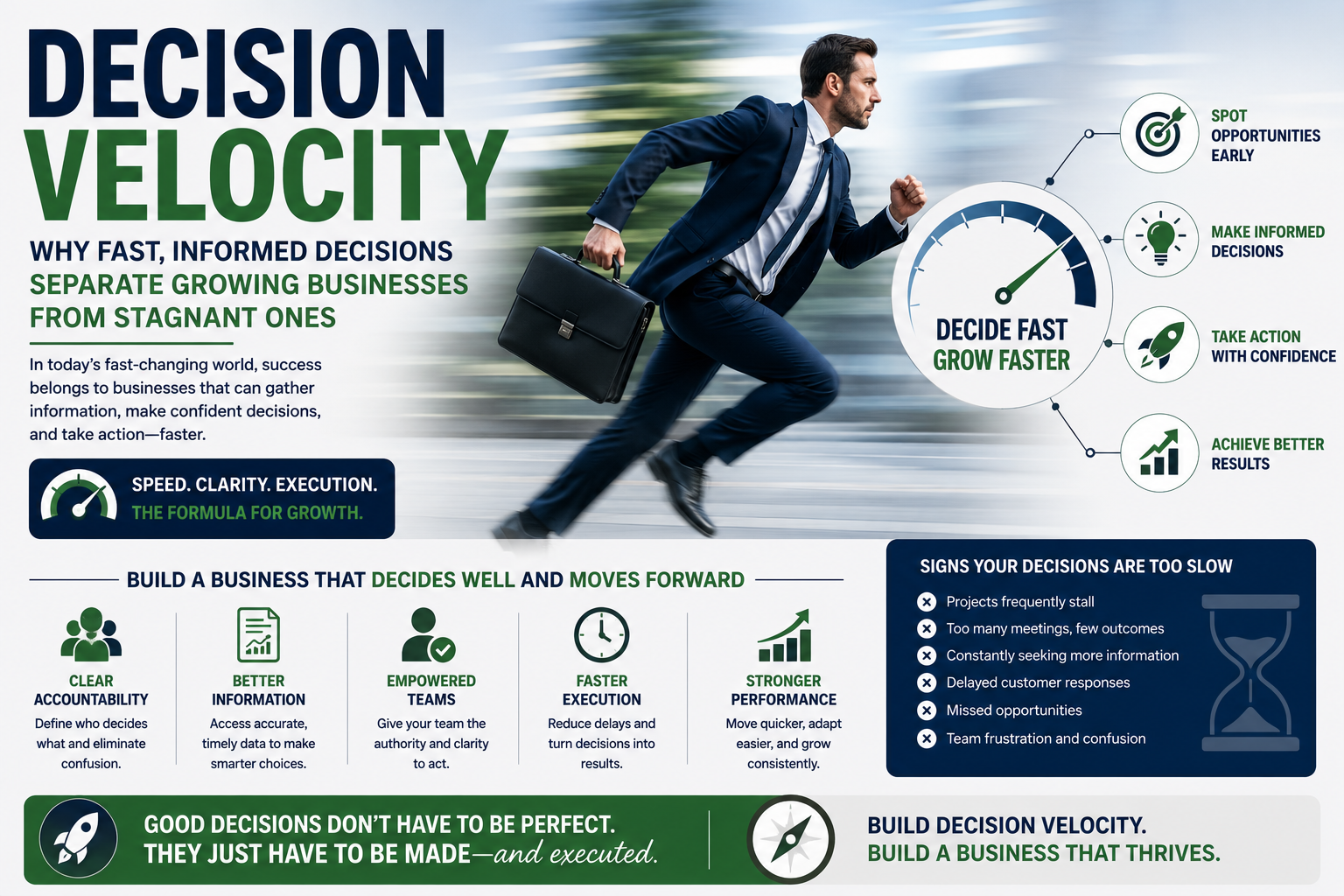
Decision velocity refers to the speed at which an organization can gather information, make informed decisions, and execute those decisions effectively.
In today’s rapidly changing business environment, companies that make good decisions quickly often outperform companies that make perfect decisions too slowly.
The ability to move with confidence is becoming a competitive advantage.
The Hidden Cost of Slow Decision-Making
Most business owners recognize the cost of making bad decisions.
Far fewer recognize the cost of making no decision at all.
Delayed decisions often create:
- Lost sales opportunities
- Missed market trends
- Increased operational inefficiencies
- Team frustration
- Reduced accountability
- Competitive disadvantages
Many businesses become trapped in analysis paralysis.
Leadership teams spend excessive time collecting information, discussing possibilities, and debating options without taking meaningful action.
While careful planning has value, excessive deliberation often becomes a growth barrier.
Why Small Businesses Have an Advantage
Large organizations often struggle with bureaucracy.
Decisions may require:
- Multiple approvals
- Department reviews
- Committee discussions
- Executive signoff
Small businesses possess a significant advantage.
They can often:
- Identify opportunities faster
- Adapt more quickly
- Implement changes rapidly
- Respond to customer needs immediately
However, many small businesses accidentally create their own bureaucracy as they grow.
Without realizing it, they slow themselves down through unnecessary layers of approval and unclear decision authority.
The Difference Between Fast Decisions and Reckless Decisions
Decision velocity does not mean making impulsive choices.
Fast decisions are informed decisions.
Reckless decisions ignore available information.
High-performing businesses establish systems that allow leadership to:
- Access accurate information quickly
- Understand risks
- Evaluate alternatives
- Move forward confidently
The goal is not perfection.
The goal is progress.
The Role of Clear Accountability
One of the biggest causes of slow decision-making is unclear ownership.
Teams often become stuck when nobody knows who has authority to make a decision.
Questions remain unresolved because:
- Multiple people believe someone else owns the issue
- Approval processes are unclear
- Accountability is shared too broadly
Growing businesses establish clear ownership.
Every major decision should have a clearly identified decision-maker.
This improves speed and reduces confusion.
Building Information Systems That Support Decisions
Many businesses struggle with decision velocity because they lack timely information.
Leadership should have visibility into:
- Revenue performance
- Profitability
- Cash flow
- Customer trends
- Operational capacity
- Project status
When information is delayed or inaccurate, decisions become slower and riskier.
Strong reporting systems improve confidence and accelerate execution.
Empowering Teams to Make Decisions
Businesses cannot scale if every decision requires owner involvement.
As organizations grow, leaders must develop teams capable of making sound decisions independently.
This requires:
- Clear expectations
- Defined authority levels
- Training
- Accountability
Empowered teams solve problems faster.
They also reduce leadership bottlenecks that limit growth.
The Relationship Between Decision Velocity and Innovation
Innovation often depends on experimentation.
Businesses that move slowly frequently miss opportunities because they spend too much time seeking certainty.
Innovative organizations typically:
- Test ideas quickly
- Learn from outcomes
- Adjust rapidly
- Iterate continuously
The willingness to make informed decisions and learn from results often creates more progress than waiting for perfect information.
Creating a Decision-Making Framework
One way to improve decision velocity is to create structured decision frameworks.
For example:
Low-Risk Decisions
Make immediately.
Moderate-Risk Decisions
Gather relevant information and decide within a defined timeframe.
High-Risk Decisions
Conduct deeper analysis while maintaining decision deadlines.
This prevents every decision from receiving the same level of scrutiny.
Measuring Decision Effectiveness
Businesses often evaluate decisions based solely on outcomes.
A better approach evaluates:
- Decision quality
- Available information
- Execution effectiveness
- Learning opportunities
Even good decisions sometimes produce unfavorable outcomes.
The objective is building a consistent process that improves decision quality over time.
Common Signs Your Business Has a Decision Velocity Problem
Watch for these warning signs:
- Projects frequently stall
- Excessive meetings without outcomes
- Constant requests for additional information
- Delayed customer responses
- Leadership bottlenecks
- Missed opportunities
- Team frustration
These symptoms often indicate decision-making systems need improvement.
How Faster Decisions Create Competitive Advantage
Businesses that consistently make informed decisions faster often experience:
- Increased agility
- Faster growth
- Better customer service
- Stronger team engagement
- Greater innovation
- Improved profitability
Speed alone is not enough.
But speed combined with information, accountability, and execution creates powerful advantages.
Final Thoughts
Growth rarely comes from having all the answers.
It comes from creating systems that allow your business to learn, adapt, and move forward confidently.
Decision velocity is not about rushing.
It is about eliminating unnecessary delays, improving information flow, clarifying accountability, and empowering people to act.
The businesses that thrive in changing markets are often not the ones with the perfect strategy.
They are the ones capable of executing good decisions consistently and quickly.
In a competitive environment, the ability to decide may be just as important as the decision itself.