

Many business owners assume growth challenges are caused by external factors.
They blame:
- Economic conditions
- Competition
- Marketing performance
- Rising costs
- Staffing shortages
While these factors certainly influence performance, many businesses are slowed by something happening internally:
Organizational drag.
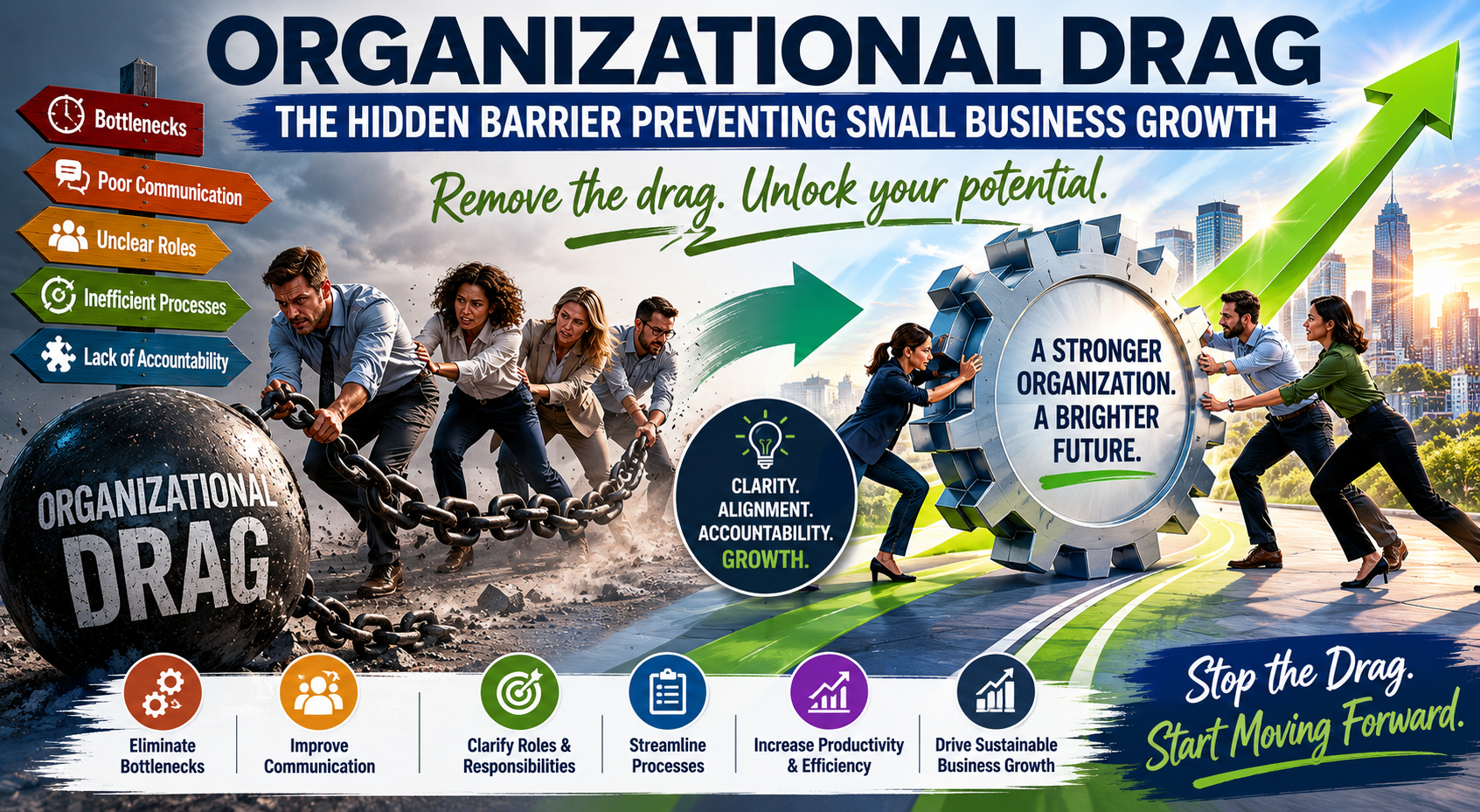
Organizational drag refers to the collection of inefficiencies, bottlenecks, communication breakdowns, unclear responsibilities, and operational friction that gradually slow a business as it grows.
Unlike obvious financial problems, organizational drag often develops quietly.
The business continues operating.
Revenue may still increase.
Customers continue buying.
Yet progress becomes increasingly difficult.
Simple tasks take longer.
Projects stall.
Employees become frustrated.
Leadership feels overwhelmed.
The business works harder while achieving less.
What Is Organizational Drag?
Organizational drag occurs when the systems, processes, and structures that once supported growth begin limiting it.
Examples include:
- Unclear decision-making authority
- Repeated communication failures
- Duplicate work
- Constant firefighting
- Poor delegation
- Inefficient workflows
- Lack of accountability
- Inconsistent processes
Each issue may seem minor on its own.
Together, they create significant resistance throughout the organization.
Why Growth Often Creates More Drag
Ironically, growth itself is often the source of organizational drag.
When businesses are small:
- Communication is simple
- Decision-making is fast
- Responsibilities are clear
- Processes are informal
As companies grow, complexity increases.
New employees join.
Departments form.
Systems multiply.
Without intentional structure, complexity creates confusion.
The very growth a business seeks can begin slowing future growth.
The Hidden Cost of Constant Firefighting
Many organizations operate in reactive mode.
Leaders spend their days solving:
- Customer issues
- Employee problems
- Operational breakdowns
- Financial surprises
- Missed deadlines
When teams constantly react, they rarely improve underlying systems.
The same problems continue recurring.
This cycle consumes valuable time and energy.
Businesses trapped in firefighting often struggle to focus on strategic growth initiatives.
Decision Bottlenecks and Leadership Overload
One of the most common forms of organizational drag occurs when every decision flows through leadership.
Owners frequently become involved in:
- Operational decisions
- Customer issues
- Hiring choices
- Financial approvals
- Project management
This creates bottlenecks.
Employees wait for approvals.
Projects slow down.
Leadership becomes overwhelmed.
The business becomes dependent on a small number of decision-makers.
Sustainable growth requires distributing decision-making authority appropriately.
How Unclear Accountability Slows Performance
Many businesses struggle because ownership is unclear.
Questions arise:
- Who is responsible?
- Who has authority?
- Who follows up?
- Who ensures completion?
When accountability is vague, tasks often remain unfinished.
Employees assume someone else is handling the issue.
Strong organizations establish clear ownership for outcomes, projects, and responsibilities.
Clarity accelerates execution.
Communication Breakdown Creates Organizational Friction
Communication problems rarely appear on financial statements.
However, they frequently impact profitability.
Examples include:
- Missed information
- Conflicting priorities
- Duplicate efforts
- Delayed responses
- Misunderstood expectations
As organizations grow, communication systems become increasingly important.
Businesses that communicate effectively typically execute more efficiently.
Why Process Documentation Matters
Many growing businesses rely heavily on tribal knowledge.
Critical information exists only in the minds of key employees.
When knowledge is undocumented:
- Training becomes difficult
- Mistakes increase
- Consistency declines
- Scalability suffers
Documented processes create operational stability.
They reduce dependency on specific individuals and improve organizational resilience.
The Relationship Between Organizational Drag and Profitability
Organizational drag directly affects financial performance.
Examples include:
Increased Labor Costs
Employees spend time navigating inefficiencies.
Lower Productivity
More effort produces fewer results.
Delayed Projects
Growth initiatives take longer to implement.
Customer Frustration
Service quality may decline.
Leadership Burnout
Owners spend more time managing problems than building the business.
Reducing organizational drag often improves profitability without increasing revenue.
Signs Your Business Is Experiencing Organizational Drag
Warning signs include:
- Projects frequently stall
- Employees struggle to prioritize
- Leadership feels overwhelmed
- Meetings rarely produce outcomes
- Teams operate in silos
- Customer issues repeat frequently
- Growth feels increasingly difficult
These indicators often suggest systems require improvement.
Building a More Agile Organization
Organizations reduce drag by creating clarity.
Key areas include:
Defined Roles
Employees understand responsibilities and expectations.
Standardized Processes
Consistency improves efficiency.
Clear Decision Authority
Teams know who makes decisions.
Accountability Systems
Ownership is visible and measurable.
Continuous Improvement
Processes evolve as the business grows.
Agile organizations adapt more effectively to change and growth.
Why Strong Systems Create Freedom
Many business owners fear that structure reduces flexibility.
In reality, effective systems create freedom.
Strong systems allow businesses to:
- Scale efficiently
- Delegate confidently
- Improve consistency
- Reduce risk
- Focus on strategic priorities
The goal is not bureaucracy.
The goal is clarity.
The Long-Term Competitive Advantage
Organizations that minimize drag often outperform competitors because they:
- Execute faster
- Adapt more easily
- Communicate effectively
- Allocate resources efficiently
- Maintain operational consistency
These advantages compound over time.
Small operational improvements frequently create substantial long-term results.
Final Thoughts
Most businesses do not fail because of a lack of opportunities.
They struggle because internal friction gradually limits their ability to capitalize on those opportunities.
Organizational drag is often invisible until growth begins to stall.
By improving accountability, clarifying roles, strengthening communication, documenting processes, and reducing unnecessary complexity, businesses can remove barriers that limit performance.
Sometimes the next stage of growth does not require doing more.
It requires eliminating what is slowing you down.